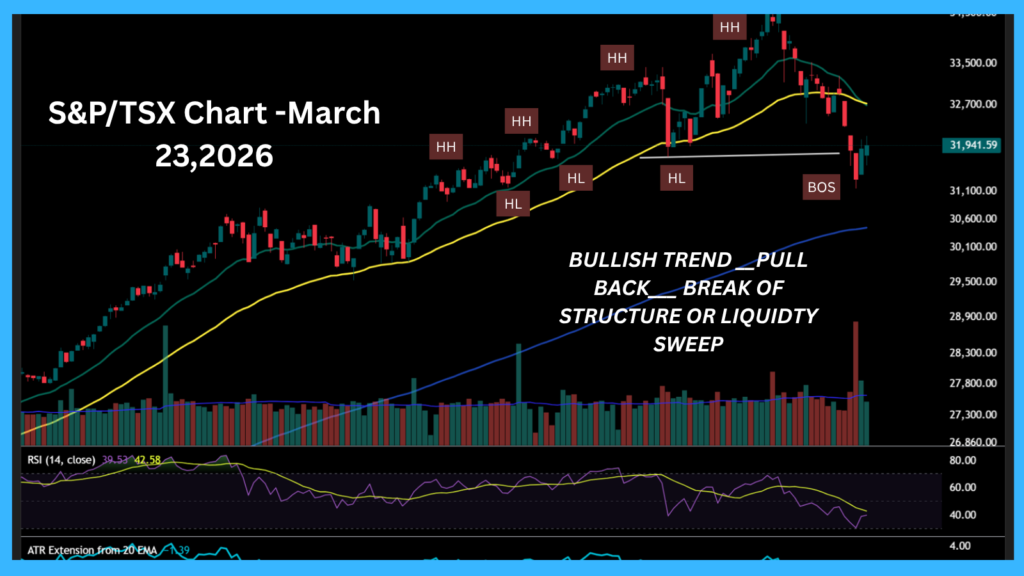
Markets often reward patience more than prediction.
Right now, I’m resisting the urge to chase headlines and instead focusing on what the market is actually telling us through price action.
One of the key themes I’m watching is the continued strength of the U.S. Dollar Index (DXY), currently trading around 102.24, while the U.S. 10-Year Treasury Yield remains elevated near 5.225%. These two forces matter because they can influence capital flows, borrowing costs, investor sentiment, and sector leadership across North American markets.
A stronger U.S. dollar and elevated bond yields generally create a more demanding environment for equities. When yields rise, investors suddenly have a higher risk-free return available, forcing stocks to work harder to attract capital. In these conditions, not every sector participates equally. Some sectors show resilience, while others struggle to regain momentum.
That brings me to the Canadian market.
Watching the TSX Financial Sector
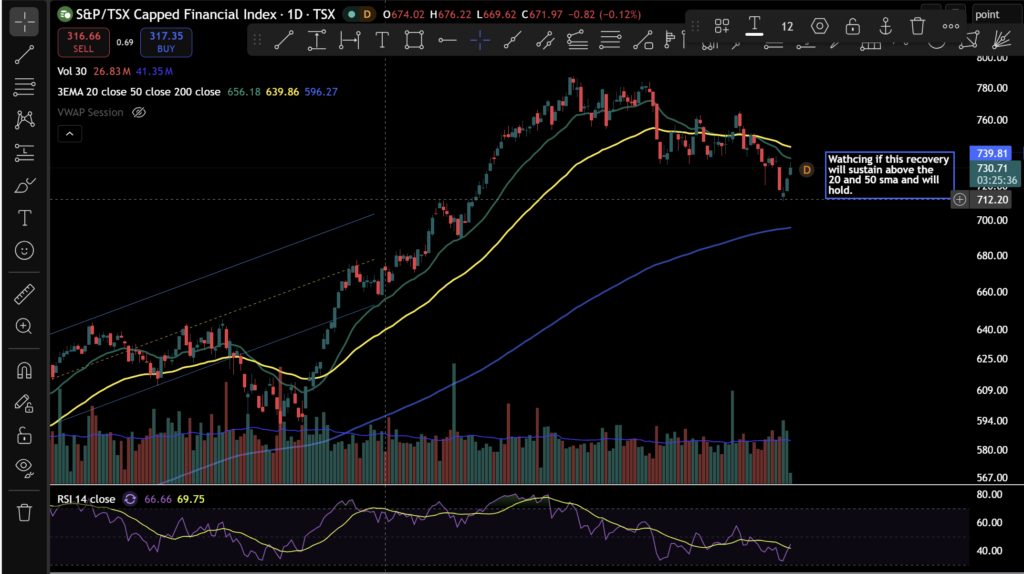
The TSX Financial Sector Index has caught my attention.
After experiencing a meaningful decline that pushed price below both the 20-day and 50-day moving averages, the index appears to be attempting a recovery. Importantly, despite the weakness, it has remained above its 200-day moving average, suggesting that the longer-term trend may still be intact.
This creates an interesting setup.
Rather than treating the initial bounce as a signal to buy, I want to see proof that buyers can reclaim and hold above both the 20-day and 50-day moving averages. These moving averages often act as a gauge of intermediate-term momentum. A successful recovery above them could indicate that institutional money is returning to the sector.
However, I am even more interested in something else:
Leadership.
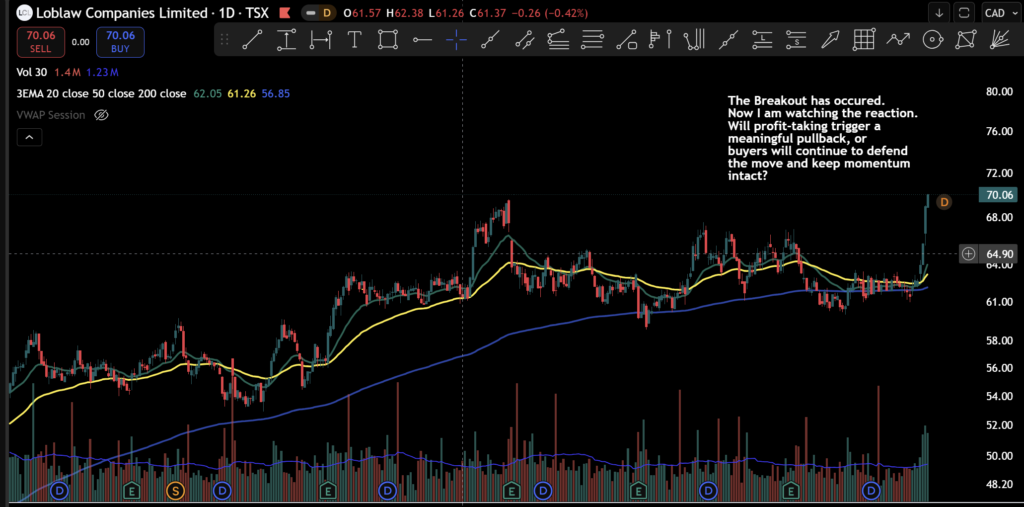
History shows that strong sectors are often led higher by a handful of stocks that begin recovering before the broader index turns convincingly upward. Before allocating significant attention to the index itself, I want to identify financial stocks that are already displaying relative strength, improving trend structure, and stronger accumulation signals.
If sector leaders begin advancing while the index is still in recovery mode, that may provide an early clue about the direction of the broader financial sector.
Applying the Same Framework to Consumer Staples
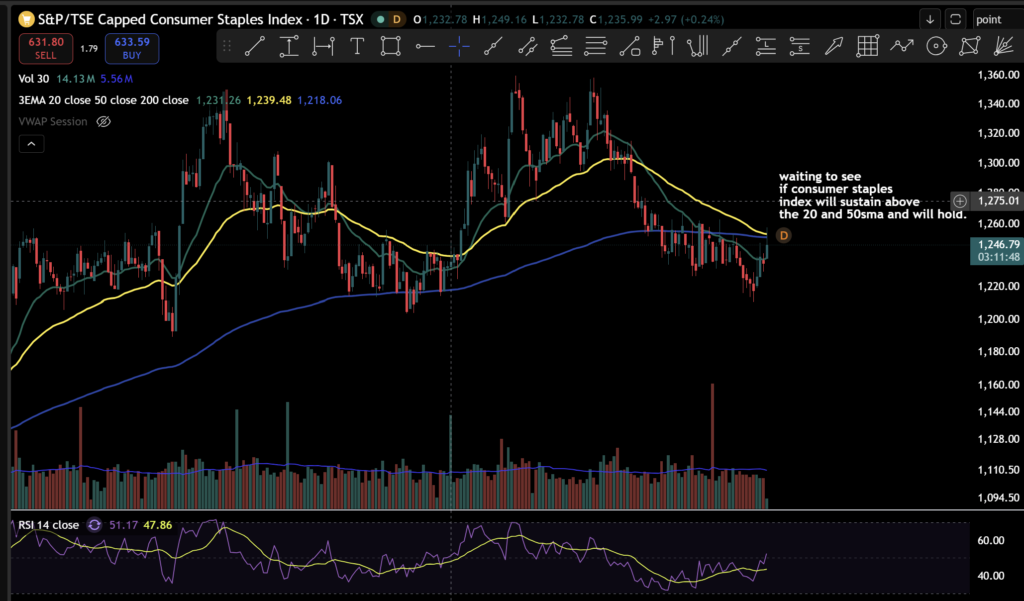
I am approaching the TSX Consumer Staples sector with the same mindset.
Instead of trying to predict the bottom, I want the market to show evidence that demand is returning.
The checklist is straightforward:
- Is price recovering above key moving averages?
- Is momentum improving?
- Are leading stocks showing strength before the index confirms?
- Is volume supporting the move?
- Does the sector continue to outperform the broader market?
When several of these factors begin aligning, the odds of a sustainable move improve considerably.
Consumer staples often behave differently from more cyclical sectors, especially during periods of economic uncertainty, elevated interest rates, or defensive market positioning. Because of this, watching how the sector responds to current macro conditions may offer valuable clues about investor expectations.
The Bigger Picture
At this stage, I am not looking for certainty.
I am looking for evidence.
The dollar remains strong. Treasury yields remain elevated. Those are important macro forces that deserve respect. Yet markets are forward-looking, and sectors often begin turning long before the economic narrative becomes obvious.
That’s why my focus remains on price action.
If TSX Financials and TSX Consumer Staples can reclaim important moving averages while sector leaders begin outperforming, it may signal that capital is quietly rotating back into these areas.
Until then, patience remains the strategy.
The next meaningful opportunity may not come from predicting what happens next. It may come from recognizing the moment when the market begins to reveal it
The best trades rarely start with excitement. They start with observation. Right now, I’m observing the relationship between a strong U.S. dollar, elevated Treasury yields, and the price action developing within Canadian financials and consumer staples. The goal isn’t to be first. The goal is to be right when the evidence arrives.