
- Confirmation Arrives, But Patience Remains: Consumer Staples Show Strength While the Broader Market Still Struggles
Confirmation Arrives, But Patience Remains: Consumer Staples Show Strength While the Broader Market Still Struggles
A few days ago, I wrote about waiting for confirmation in the TSX Consumer Staples sector.
At the time, the objective was simple: let the market prove itself before assuming a bottom was in place. Rather than predicting a reversal, I wanted to see price reclaim key moving averages and show evidence that buyers were willing to step back in.
Today, the market has given us an important update.
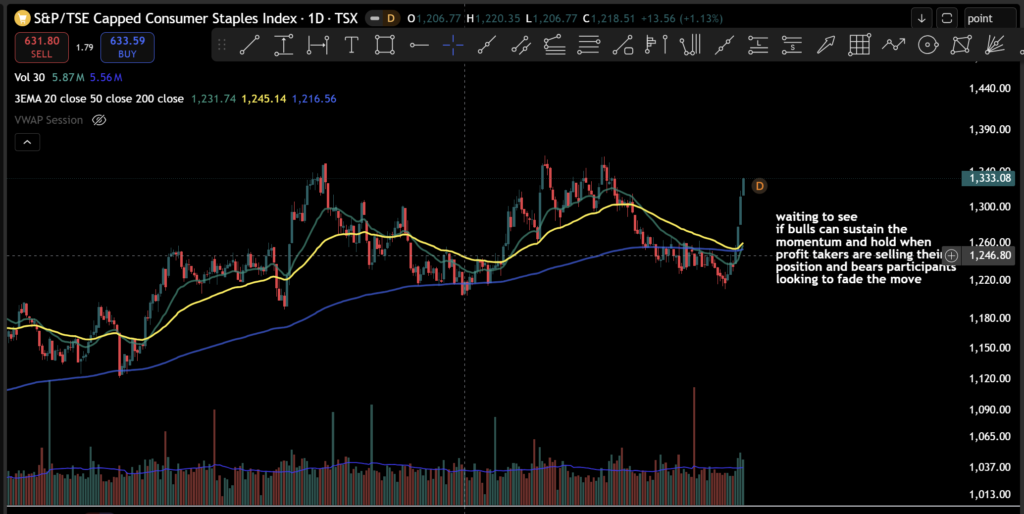
The TSX Consumer Staples Index has now broken above its 20-day, 50-day, and 200-day moving averages with strong momentum. Even more importantly, the move did not occur through a slow drift higher. Buyers stepped in aggressively, producing an expansion in price and a noticeable increase in momentum.
For price action traders, this is exactly the kind of behavior worth paying attention to.
But while confirmation has arrived, the question now becomes:
Can the bulls hold what they have gained?
The Real Test Begins After the Breakout
Many traders focus on the breakout itself.
Experienced traders often focus on what happens next.
Strong momentum can attract buyers, but it can also attract profit-taking and bearish participants looking to fade the move. The most important information may come during the first meaningful pullback.
Will sellers immediately push the Consumer Staples Index back below its moving averages?
Or will buyers defend the breakout and establish those moving averages as support?
That battle will likely determine whether this becomes the beginning of a larger trend or simply a short-lived rally.
For now, the evidence has improved significantly, but I am still more interested in observing the market’s response than forecasting the next move.
Looking for Leadership: Loblaw Steps Forward
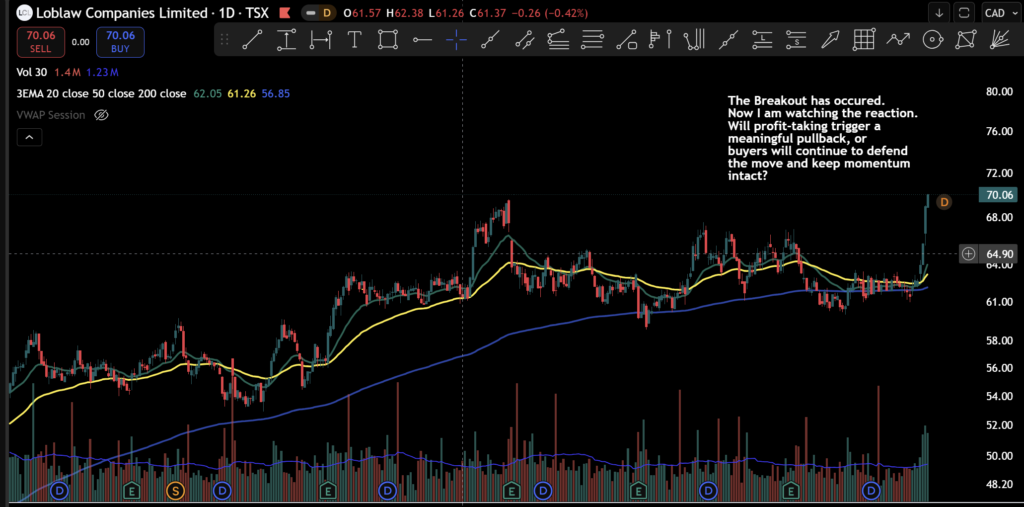
One stock that immediately stands out is Loblaw Companies Limited (TSX: L).
In my previous article, I mentioned that sector leaders often reveal themselves before the broader market fully establishes a new trend.
Loblaw may be doing exactly that.
The stock has broken above its 20-day, 50-day, and 200-day moving averages with strong momentum, while price has pushed into new highs not seen in recent months. Volume has also expanded as buyers stepped aggressively into the stock.
This is precisely the type of price action I want to see from a potential sector leader.
However, strong momentum alone is not enough for me to take a position.
The market often rewards patience after large price expansions.
Rather than chasing the move, I want to observe how the bears respond.
If sellers cannot meaningfully push Loblaw back below key support levels, it would suggest that institutional demand remains strong. A successful retest followed by renewed buying pressure would increase my confidence far more than buying into an extended move.
For now, Loblaw remains on my watchlist rather than in my portfolio.
A Sector Showing Strength While the Market Hesitates
What makes Consumer Staples particularly interesting is the contrast with the broader market.
While the Consumer Staples Index is successfully reclaiming key moving averages, both the TSX Composite Index and the Dow Jones Industrial Average are still struggling to establish themselves above their own 20-day, 50-day, and 200-day moving averages.
That divergence deserves attention.
When a sector demonstrates relative strength while the broader market remains uncertain, it often indicates that capital is rotating toward that area of the market. Investors may be showing a preference for defensive businesses with stable cash flows while uncertainty continues elsewhere.
This does not guarantee future outperformance.
But it does provide a clue.
And clues are what price action traders look for.
What I’m Watching Next
Before considering a position, these are the questions I want the market to answer:
- Can the Consumer Staples Index hold above the 20-day and 50-day moving averages?
- Will buyers defend any pullback toward those levels?
- Can Loblaw maintain its momentum without immediately giving back gains?
- Will other Consumer Staples stocks begin showing similar leadership?
- Can the broader TSX eventually follow the sector’s strength?
The answers to those questions will likely provide far more valuable information than any prediction.
Closing Thoughts
My previous article was about waiting for confirmation.
Today, confirmation has arrived.
But confirmation does not automatically mean commitment.
The Consumer Staples sector has taken a significant step forward, and Loblaw has emerged as a potential leader. Yet the broader market remains hesitant, and breakout moves often face their toughest test after the initial excitement fades.
As always, I am letting price action lead the way.
The breakout has my attention.
The pullback, if it comes, may determine whether it earns my capital.
- Waiting on Confirmation: Why TSX Financials and Consumer Staples Are on My Watchlist
Markets often reward patience more than prediction.
Right now, I’m resisting the urge to chase headlines and instead focusing on what the market is actually telling us through price action.
One of the key themes I’m watching is the continued strength of the U.S. Dollar Index (DXY), currently trading around 102.24, while the U.S. 10-Year Treasury Yield remains elevated near 5.225%. These two forces matter because they can influence capital flows, borrowing costs, investor sentiment, and sector leadership across North American markets.
A stronger U.S. dollar and elevated bond yields generally create a more demanding environment for equities. When yields rise, investors suddenly have a higher risk-free return available, forcing stocks to work harder to attract capital. In these conditions, not every sector participates equally. Some sectors show resilience, while others struggle to regain momentum.
That brings me to the Canadian market.
Watching the TSX Financial Sector
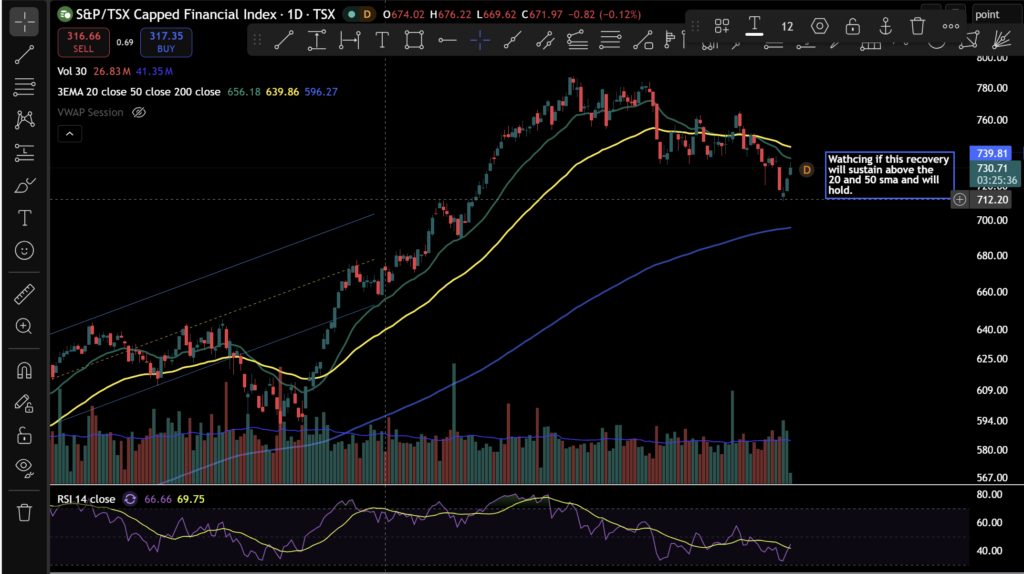
The TSX Financial Sector Index has caught my attention.
After experiencing a meaningful decline that pushed price below both the 20-day and 50-day moving averages, the index appears to be attempting a recovery. Importantly, despite the weakness, it has remained above its 200-day moving average, suggesting that the longer-term trend may still be intact.
This creates an interesting setup.
Rather than treating the initial bounce as a signal to buy, I want to see proof that buyers can reclaim and hold above both the 20-day and 50-day moving averages. These moving averages often act as a gauge of intermediate-term momentum. A successful recovery above them could indicate that institutional money is returning to the sector.
However, I am even more interested in something else:
Leadership.
History shows that strong sectors are often led higher by a handful of stocks that begin recovering before the broader index turns convincingly upward. Before allocating significant attention to the index itself, I want to identify financial stocks that are already displaying relative strength, improving trend structure, and stronger accumulation signals.
If sector leaders begin advancing while the index is still in recovery mode, that may provide an early clue about the direction of the broader financial sector.
Applying the Same Framework to Consumer Staples
I am approaching the TSX Consumer Staples sector with the same mindset.
Instead of trying to predict the bottom, I want the market to show evidence that demand is returning.
The checklist is straightforward:
- Is price recovering above key moving averages?
- Is momentum improving?
- Are leading stocks showing strength before the index confirms?
- Is volume supporting the move?
- Does the sector continue to outperform the broader market?
When several of these factors begin aligning, the odds of a sustainable move improve considerably.
Consumer staples often behave differently from more cyclical sectors, especially during periods of economic uncertainty, elevated interest rates, or defensive market positioning. Because of this, watching how the sector responds to current macro conditions may offer valuable clues about investor expectations.
The Bigger Picture
At this stage, I am not looking for certainty.
I am looking for evidence.
The dollar remains strong. Treasury yields remain elevated. Those are important macro forces that deserve respect. Yet markets are forward-looking, and sectors often begin turning long before the economic narrative becomes obvious.
That’s why my focus remains on price action.
If TSX Financials and TSX Consumer Staples can reclaim important moving averages while sector leaders begin outperforming, it may signal that capital is quietly rotating back into these areas.
Until then, patience remains the strategy.
The next meaningful opportunity may not come from predicting what happens next. It may come from recognizing the moment when the market begins to reveal it
The best trades rarely start with excitement. They start with observation. Right now, I’m observing the relationship between a strong U.S. dollar, elevated Treasury yields, and the price action developing within Canadian financials and consumer staples. The goal isn’t to be first. The goal is to be right when the evidence arrives.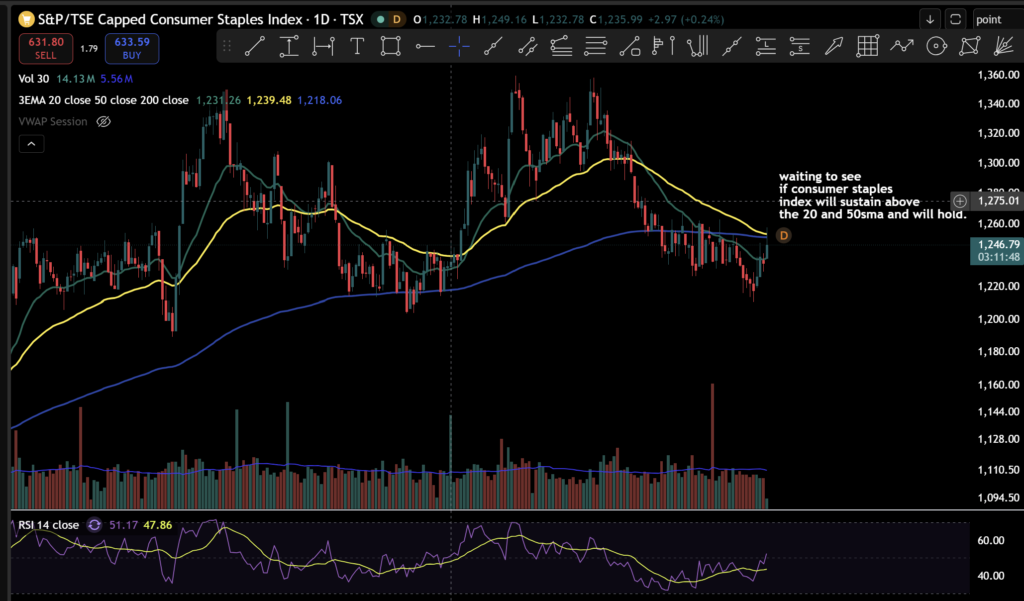
- Market Commentary — S&P/TSX

Market Commentary — S&P/TSX Composite Index (March 23 Close)
The S&P/TSX Composite Index closed the week with a meaningful pullback, breaking below the previous swing low. This move marks a potential break of structure or change of character, signaling that momentum may be shifting—at least in the short term.
Here’s what stands out:
1. Clear Break Below the Previous Low
Price pushed through the prior swing low, creating:
- A lower low
- A potential bearish structure shift
- A sign that buyers temporarily lost control
This is the first real sign of weakness after a strong upward leg.
The key question now is whether this break represents:
- A true structural shift, or
- A liquidity sweep designed to grab stops before continuing higher
Both scenarios remain open.
2. Liquidity Sweep Is Still on the Table
The break of the low was clean and decisive, but not impulsive. This type of move often acts as:
- A stop‑run
- A liquidity grab
- A reset before a new leg higher
If this was a sweep, we should soon see:
- A strong rejection
- A higher low forming
- A shift back into bullish structure
This is the behavior to watch next.
3. Watching for a Higher Low Formation
If buyers step back in, the next important signal will be:
A higher low forming above the swept level
This would show:
- Absorption of selling
- Re‑accumulation
- A potential continuation of the larger trend
A higher low after a sweep is one of the strongest continuation signals in price action.
4. If No Higher Low Forms…
If price fails to form a higher low and instead:
- Breaks down again
- Rejects from lower highs
- Shows weak reactions at key zones
Then the break of structure was likely genuine, not a sweep.
This would open the door to:
- A deeper pullback
- A retest of lower reaction zones
- A shift into a short‑term bearish cycle
5. What Matters Next
The next few candles will reveal the intent behind the break.
Key things to watch:
- Does price reclaim the broken low?
- Does a higher low form?
- Do we see a strong reaction from buyers?
- Does momentum shift back upward?
This is the decision point.
Summary
The S&P/TSX has broken below a key low, signaling either:
- A true structural shift, or
- A liquidity sweep before continuation
The next higher low—or failure to form one—will reveal the market’s direction.